


Your shopping cart is empty!
Camphor basil (African blue basil, Kilimanjaro Basil)
Eco seeds
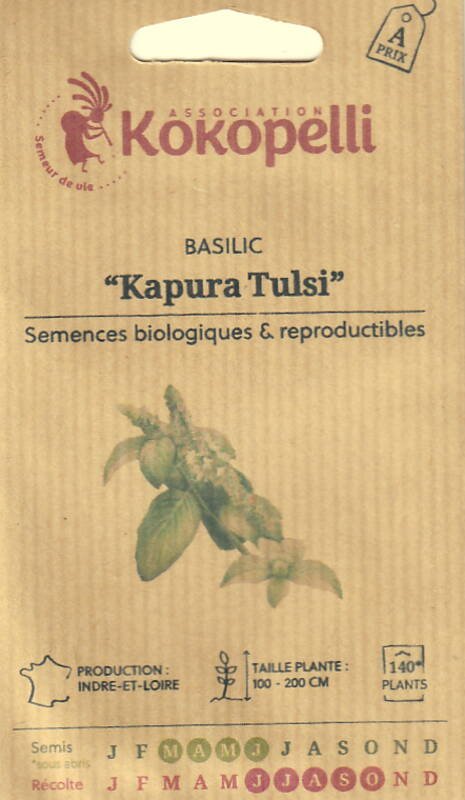
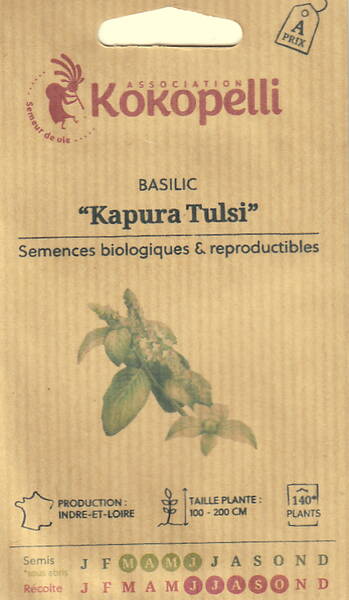
Kilimanjaro Basil (African Blue Basil or Camphor Basil) - Ocimum kilimandscharicum = Ocimum johnstonii = Ocimum tortuosum.
A perennial subshrub from the Mint family (Lamiaceae).
A rare and incredibly useful plant that is grown as an annual in the cool climate of Northern Europe.
It forms green, fuzzy leaves with a very strong camphor scent. The flowers are white with reddish-orange pollen.
The stems are green-purple, hairy, with sessile glands. The leaves are oblong-elliptical, 25-40 mm long and 10-20 mm wide, with serrated edges, densely covered with white hairs on both sides.
The inflorescence is dense. The calyx is 2-3.5 mm long at the pedicel, 3-4.5 mm long at the fruit. The corolla is white, with a slight purple tint, 3-4 mm long, and the lobes are hairy on the back. The nutlet is black, ovoid, smooth or finely warty, and produces mucilage when wet.
It reaches 60 cm in height (and sometimes almost 2 meters under very good growing conditions).
Ocimum kilimandsharicum is highly resistant to the fungus Fusarium oxysporum ssp. basilicii, as well as to basil downy mildew Peronospora belbahrii.
The leaves are used as a savory flavoring in food products. The plant also has powerful medicinal properties, yields valuable essential oil, and is effectively used as a natural insect repellent.
The main component of its essential oil is camphor. It is used as a raw material for producing camphor oil, as an excellent honey plant, and for flavoring tea.
Ocimum kilimandscharicum – is a unique plant that harmoniously combines ornamental appeal, medicinal properties, and culinary value. It is perfectly suited for growing in gardens, greenhouses, and even as a potted indoor plant. If you are looking for a fragrant and useful herb with an exotic origin, Kilimanjaro Basil will be an excellent choice.
For successful cultivation, it is important to provide it with enough sunlight, moderate watering, and reliable protection from autumn frosts. With proper care, the plant will delight you with abundant fragrant greenery and beneficial properties throughout the season.
A perennial subshrub from the Mint family (Lamiaceae).
A rare and incredibly useful plant that is grown as an annual in the cool climate of Northern Europe.
It forms green, fuzzy leaves with a very strong camphor scent. The flowers are white with reddish-orange pollen.
The stems are green-purple, hairy, with sessile glands. The leaves are oblong-elliptical, 25-40 mm long and 10-20 mm wide, with serrated edges, densely covered with white hairs on both sides.
The inflorescence is dense. The calyx is 2-3.5 mm long at the pedicel, 3-4.5 mm long at the fruit. The corolla is white, with a slight purple tint, 3-4 mm long, and the lobes are hairy on the back. The nutlet is black, ovoid, smooth or finely warty, and produces mucilage when wet.
It reaches 60 cm in height (and sometimes almost 2 meters under very good growing conditions).
Ocimum kilimandsharicum is highly resistant to the fungus Fusarium oxysporum ssp. basilicii, as well as to basil downy mildew Peronospora belbahrii.
The leaves are used as a savory flavoring in food products. The plant also has powerful medicinal properties, yields valuable essential oil, and is effectively used as a natural insect repellent.
The main component of its essential oil is camphor. It is used as a raw material for producing camphor oil, as an excellent honey plant, and for flavoring tea.
Ocimum kilimandscharicum – is a unique plant that harmoniously combines ornamental appeal, medicinal properties, and culinary value. It is perfectly suited for growing in gardens, greenhouses, and even as a potted indoor plant. If you are looking for a fragrant and useful herb with an exotic origin, Kilimanjaro Basil will be an excellent choice.
For successful cultivation, it is important to provide it with enough sunlight, moderate watering, and reliable protection from autumn frosts. With proper care, the plant will delight you with abundant fragrant greenery and beneficial properties throughout the season.
* The homeland of Kilimanjaro basil is the mountainous regions of East Africa.
This species of basil is distinguished by its high content of essential oils (camphor, eugenol, linalool), relative cold tolerance (for a basil), and a pronounced camphor-mint aroma. Unlike common sweet basil (Ocimum basilicum), it possesses stronger medicinal properties and is widely used in medicine, cooking, and aromatherapy.
Botanical features:
-
Height: from 60 to 120 cm (in tropical conditions it can reach 2 m).
-
Stem: straight, branched, with a beautiful purple hue.
-
Leaves: green with purple veins, slightly fuzzy, pointed, up to 10 cm long.
-
Flowers: small, white-pink or lilac, gathered in dense spike-like inflorescences.
-
Aroma: intense, with refreshing camphor, woody, and minty notes.
Beneficial properties and applications:
1. Medicinal properties:
-
Anti-inflammatory and antibacterial action – used for colds, coughs, and infections.
-
Analgesic effect – helps with headaches and muscle pain.
-
Natural repellent – effectively repels mosquitoes and other annoying insects.
-
Antioxidant activity – helps slow down cell aging processes.
2. Culinary use:
-
Leaves are added to teas, savory marinades, and meat dishes (due to the very strong aroma, they are used in small quantities).
-
The essential oil is used in aromatherapy to relieve stress and improve breathing.
3. Garden benefits:
-
Attracts bees and other beneficial pollinators, significantly improving the yield of neighboring crops.
-
Can be used in companion planting as a powerful natural insecticide.
Growing and care.
Climate conditions:
-
Heat-loving, but tolerates short cold spells down to +5°C (any sub-zero frosts are fatal!).
-
In regions with cold winters, it is grown as an annual or moved indoors to a warm room in autumn.
Planting:
-
By seeds: sown in March-April for seedlings or directly outdoors after the soil has warmed up to +15°C.
-
By cuttings: roots very easily in water or moist substrate.
Location and soil:
-
Prefers open sunny areas or light partial shade.
-
The soil should be light, well-drained, with neutral acidity.
Watering:
-
Moderate, strictly without waterlogging. The variety is quite drought-resistant, but with a lack of moisture, the leaves become much smaller.
Pruning and shaping:
-
Pinching the top perfectly stimulates bushiness.
-
Regular pruning (harvesting) extends the vegetative period.
Precautions:
-
Due to the very high camphor content, it is not recommended for pregnant women and people with epilepsy.
-
In large doses, oral consumption can cause dizziness and nausea.
Traditionally, this type of basil is used in East Africa for its medicinal properties for colds, coughs, bronchitis, abdominal pain, diarrhea, measles, nervous system disorders, tumors, microbial and fungal infections, etc., as well as for protection against mosquitoes.